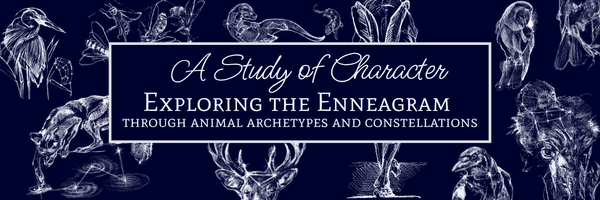

The image above captures the basic concept of what I’ve been working on: each Enneagram type is paired with an animal and a constellation that reflect the core characteristics of that personality.
If you’d like to dive deeper into the reasoning, keep reading. If not, thanks for spending a few seconds with my artwork. My hope, as always, is that you find something that resonates.
I’ve always been fascinated by pattern recognition and the role it plays in my creative process. When life becomes chaotic, I instinctively start organizing, categorizing, and looking for connections. The Enneagram appeals to that part of my brain. Exploring personality types feels a bit like collecting rocks on the beach. I examine their saturated colors and admire their shiny imperfections. It feels mediative.
The project began with a simple question: what animal best embodies the behavioral patterns of each Enneagram type?
From there, the idea evolved. Each illustration incorporates a hidden constellation selected not only for its mythology, but for how its story parallels the underlying motivations of the Enneagram type it accompanies. The constellation is woven directly into the composition, becoming part of the animal itself.
Even the placement of each constellation carries meaning. Some are embedded in the chest, others in the head, a reflection, or a surrounding structure. These locations were chosen intentionally to reflect how each type processes the world through instinct, identity, relationships, thought, or perception.
Here is a breakdown of each Enneagram type and the reasoning behind its animal and constellation pairing:


1 — Heron × Orion
Symbolic reasoning:
The spiderweb introduces a structural metaphor: tension, calibration, and precision distributed across a system. Orion’s linear geometry embedded in the web reinforces Type 1’s orientation toward order, ethical alignment, and structural integrity. The Heron becomes the agent that navigates this calibrated environment — a stabilizing presence within a network that demands balance.

2 — Honey Bee × Coma Berenices
Symbolic reasoning:
The honeycomb is a cooperative architecture — mathematically efficient, socially dependent, and resource‑oriented. Embedding Coma Berenices within this structure emphasizes Type 2’s relational function: sustaining systems through connection and contribution. The constellation’s historical association with voluntary devotion aligns with the Bee’s role in maintaining collective stability.

3 — Crow × Corvus
Symbolic reasoning:
Placing Corvus within the Crow’s chest shifts the symbolism from external performance to internal signal processing. Type 3’s core tension — authenticity vs. image — becomes anatomically centered. The constellation acts as an internal calibration device, suggesting that the Achiever’s most meaningful work is the integration of internal motive with external action.

4 — Fox × Cassiopeia
Symbolic reasoning:
A reflection introduces perceptual distortion, inversion, and subjective interpretation — all central to Type 4’s identity formation. Cassiopeia’s oscillating orientation in the sky mirrors this instability. By placing the constellation in the water’s surface, the symbolism emphasizes the Individualist’s tendency to derive meaning from internal reflection rather than external structure.

5 — Owl × Lyra
Symbolic reasoning:
The wooden post is a static support structure — a stable platform for observation. Embedding Lyra within it reframes the constellation as a foundation for analysis rather than an aesthetic object. Type 5’s cognitive stance is represented as structural: knowledge as a framework, not an ornament. The Owl’s perch becomes the site where complexity is organized into coherence.

6 — Hare × Lepus
Symbolic reasoning:
Locating Lepus in the Hare’s chest during a moment of hypervigilant motion highlights Type 6’s internal threat‑assessment system. The constellation becomes a physiological metaphor for anticipatory cognition — the readiness to respond to perceived risk. The forward lunge reinforces the type’s bias toward scanning, preparing, and reacting within uncertain environments.

7 — Otter × Aquarius
Symbolic reasoning:
The torso bend captures dynamic movement, flexibility, and rapid orientation shifts — all characteristic of Type 7’s cognitive style. Embedding Aquarius in this moment emphasizes the distribution of energy, ideas, and possibilities. The constellation becomes a symbol of continuous flow, reinforcing the Enthusiast’s tendency toward expansive, future‑oriented thinking.

8 — Bear × Ursa Major
Symbolic reasoning:
The forehead placement aligns Ursa Major with executive function — decision‑making, boundary setting, and directional leadership. Type 8’s assertive stance is reframed as cognitive authority rather than brute force. The constellation’s navigational role mirrors the Challenger’s tendency to act as a stabilizing axis within social hierarchies.

9 — Deer × Libra
Symbolic reasoning:
Positioning Libra at the center of the Deer’s perceptual field emphasizes equilibrium as a cognitive process rather than a passive trait. The antlers frame the constellation like a tuning device, suggesting that Type 9’s integrative capacity arises from continuous environmental scanning and internal balancing. Harmony becomes an active, regulated state.